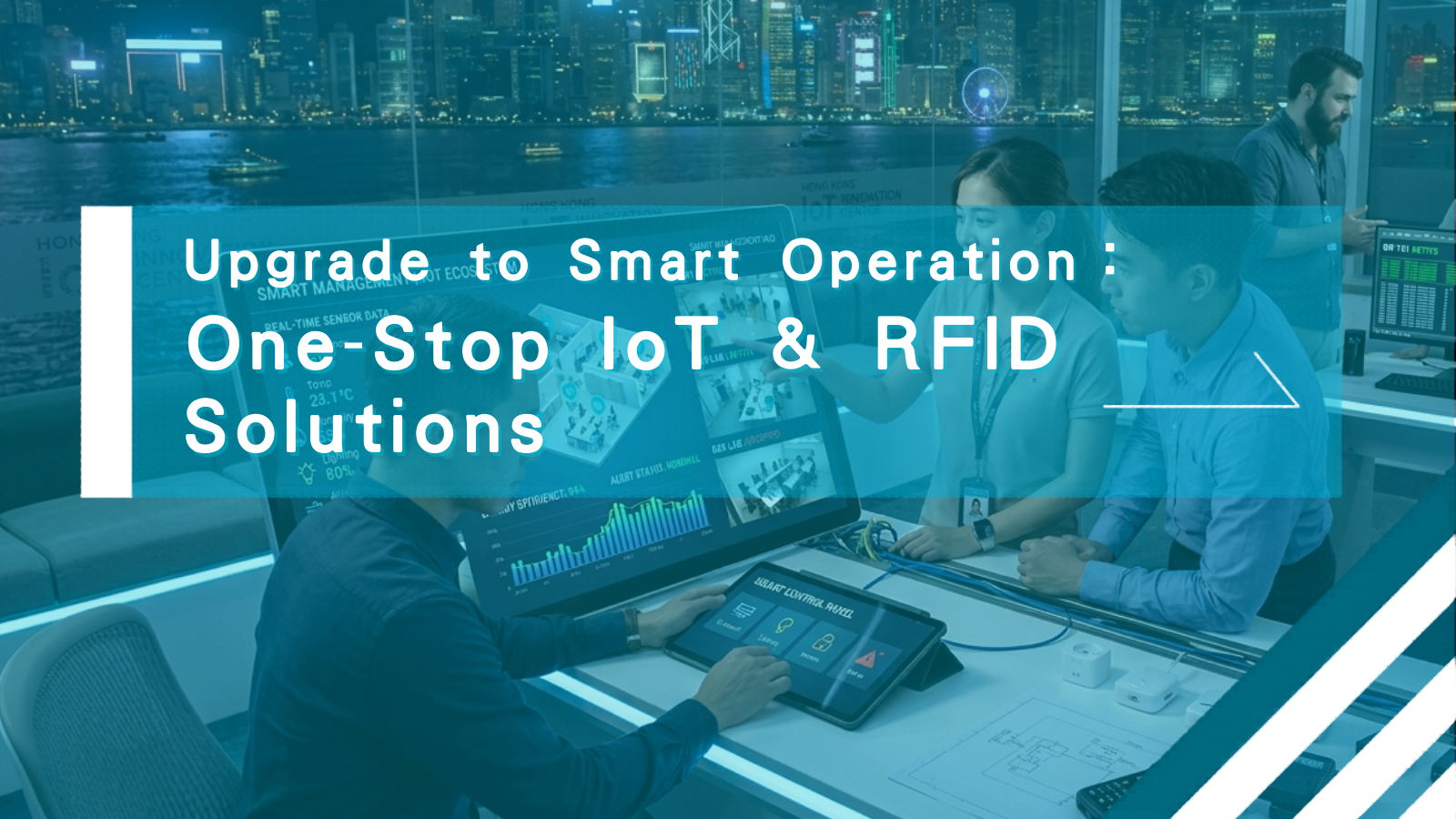
In Hong Kong, more and more organisations are looking to improve efficiency, reduce manual errors and build a stronger data foundation for decision‑making. To move from paper‑based or Excel workflows to truly data‑driven operations, the Internet of Things (IoT) has become one of the key enablers. For day‑to‑day operations teams, IoT is not a distant buzzword, but a practical way to connect equipment, assets and items to a system using sensors and tags, so that every movement and status change can be tracked and turned into usable data.
What Is IoT? Turning Frontline Actions into Usable Data
Many organisations still rely on Excel sheets, paper forms or verbal updates, which means information is often consolidated only after the fact and may not reflect what is happening on the ground. IoT solutions address this by turning everyday actions into “real‑time visible” data, allowing management and frontline staff to monitor key information at any moment.
From a practical perspective, an IoT solution usually involves three layers:
- Perception layer: Using sensors, RFID tags, barcodes, beacons and related devices to capture data such as location, identity, temperature, status and usage.
- Transmission layer: Using networks, gateways and mobile terminals to securely and reliably send data from the field to back‑end systems or cloud platforms.
- Application layer: Visualising and analysing data on applications and dashboards, issuing alerts based on pre‑defined rules, generating reports and triggering workflows where needed.
With these three layers working together, an IoT solution allows decision‑makers to move beyond gut feel or fragmented information. They can act based on real‑time data and historical trends, for example by adjusting replenishment strategies, resource allocation or maintenance planning with a clearer evidence base.
IoT and RFID/Barcode: From Identification to Smart Management
For organisations that already use barcodes or RFID, introducing IoT solutions is not a reset, but a natural upgrade path. Barcodes are mature and effective for identification and transaction recording, but typically require line‑of‑sight, one‑by‑one scanning. RFID, on the other hand, enables batch reading without aligning each item, making it well‑suited for scenarios with larger volumes, frequent movements and regular stocktaking.
When RFID/barcodes are combined with IoT devices such as gateways, smart cabinets, environmental sensors or other edge devices, the system can automatically record stock in/out, equipment usage and environment changes, then update a central platform in real time. This not only reduces repetitive manual work, but also turns inventory, assets and processes into structured data that can be used for audit, cost control, compliance and longer‑term planning. In other words, organisations can gradually move from traditional asset management towards a truly IoT‑enabled solution.
Million Tech’s Positioning as an IoT Solution Provider in Hong Kong
Million Tech has been rooted in Hong Kong for more than 30 years, focusing on Auto‑ID, RFID and related IT solutions, and in recent years has integrated these capabilities into end‑to‑end IoT solutions. As a one‑stop IoT & RFID solution provider in Hong Kong, we do more than deliver standalone products. We help organisations design and implement complete IoT solutions that fit their environment and business objectives.
Our scope covers:
- Frontline hardware: Mobile terminals, RFID readers, fixed readers, smart cabinets, kiosks and various sensing devices
- Labels and materials: RFID and barcode labels in different form factors and materials for different use cases
- System platforms: Asset and inventory management systems, IoT management platforms, dashboards and reporting tools
- Project services: Requirements study, solution design, implementation, training, as well as ongoing support and optimisation
The objective is to start from your existing processes and systems, then define a realistic roadmap for IoT and RFID, rather than forcing a “one‑size‑fits‑all” solution.
Optional AOA Technology and Customised IoT Solutions
For positioning and tracking, Million Tech can provide not only standard RFID and sensing combinations, but also optional AOA (Angle of Arrival) technology where needed to enhance indoor positioning accuracy and coverage. AOA estimates the direction and position of tags or devices by analysing the angle of received signals on multiple antennas, which is particularly useful when organisations want a clearer view of how people, equipment or assets are distributed within a site. Typical scenarios include zone‑level positioning, entry/exit detection and real‑time tracking of high‑value items, helping to build more complete IoT solutions.
Because every organisation has different site layouts, workflows and IT architectures, Million Tech approaches IoT as a customised solution exercise, not as a fixed package. In real projects, we start by understanding existing systems, stocktake cycles, risk points along the asset lifecycle, and internal manpower arrangements. We then work with the client to define a step‑by‑step technical roadmap: for example, continuing to use existing barcode where it still makes sense, introducing RFID in the most critical areas first, and then adding IoT devices, AOA and management platforms as the solution matures. With this modular and scalable design, organisations can improve their level of smart operations at a controlled pace and cost.
Measuring Results with Data and Growing IoT Step by Step
For any IoT solution to be considered successful, clear and measurable indicators are essential. As an IoT solution provider, Million Tech typically recommends setting concrete KPIs together with the client, such as reduction in stocktaking time, improvement in inventory accuracy, changes in stock‑out or overstock incidents, and hours of manual work saved. These are then tracked through built‑in reports and dashboards in the system. Such data helps management objectively evaluate the return on investment and supports business cases for future roll‑outs.
For teams that are still evaluating IoT solutions or comparing IoT solution providers in Hong Kong, a full‑scale roll‑out is not always the best starting point. A more pragmatic approach is to begin with a clearly defined pilot where impact is easy to observe, such as a specific category of high‑value assets, a single zone or a critical process. By starting small, measuring results and iterating, organisations can build internal experience, reduce transformation risk and gradually maximise the value that IoT and RFID bring to their operations. When you are ready to take the next step towards smart operations, Million Tech is ready to be your IoT solution partner in Hong Kong.

Written:Andy Ho / Head of IoT & Smart Healthcare
As an experienced IoT solutions expert, I specialise in identification technologies ranging from barcodes and RFID to facial recognition and OCR. I design warehouse management solutions for government, healthcare, education and logistics, optimising identification workflows and enabling efficient automated management.